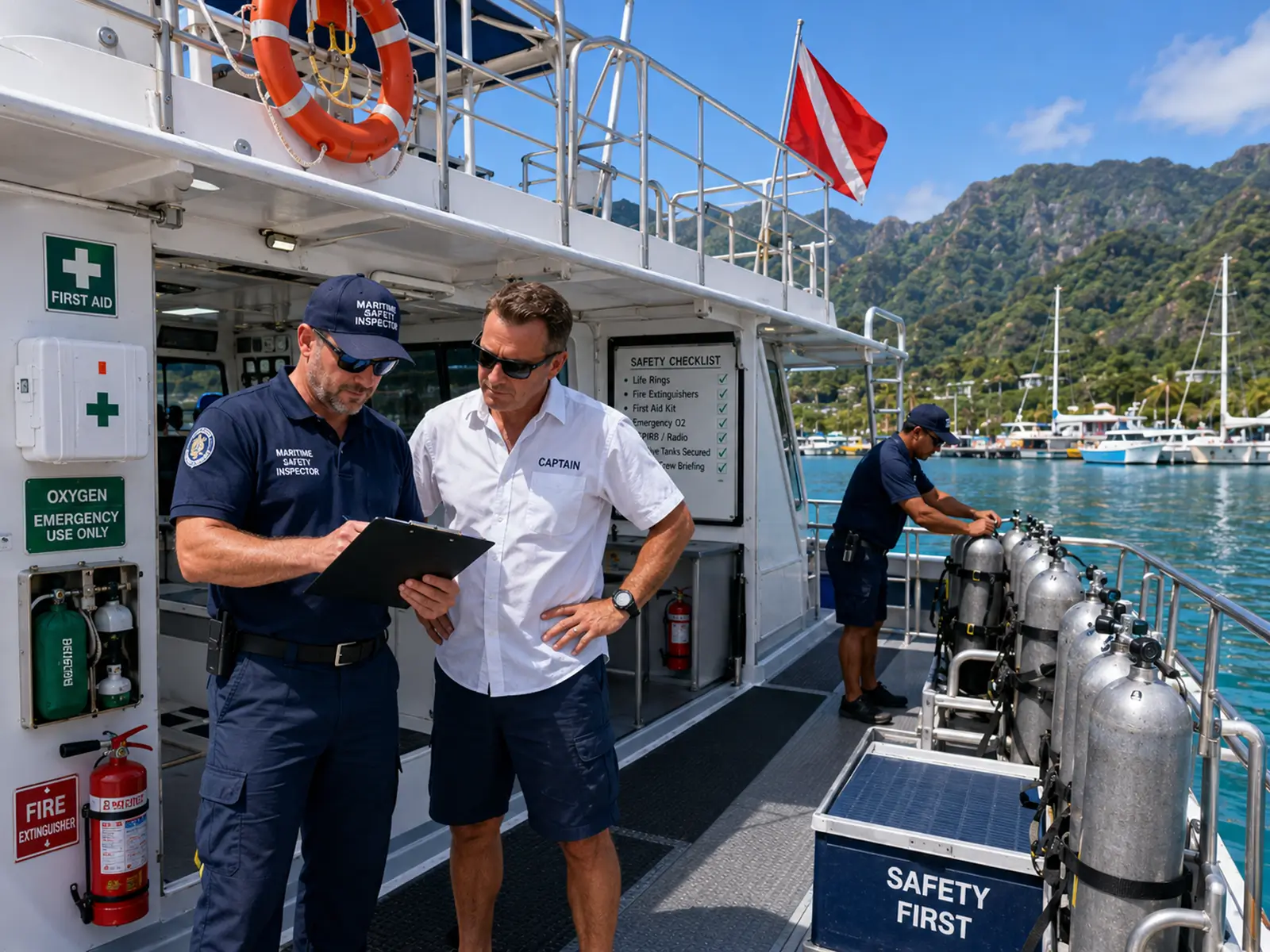
Dive Boat Safety and Compliance: What Buyers Should Check
A dive boat can look professional, clean and ready for customers — but still have serious safety or compliance problems.
For buyers, this is one of the most important parts of due diligence.
A dive boat or liveaboard is not just a business asset. It carries paying customers, crew, scuba equipment, tanks, fuel and safety responsibilities on the water. If something is wrong with registration, passenger limits, insurance, safety equipment or operating permissions, the business may not be able to run legally after the sale.
Even worse, weak safety systems can put customers, crew and the buyer’s investment at risk.
On "Dive Listings", buyers can compare dive boats, liveaboards and scuba business opportunities. But before making an offer on any vessel-based operation, safety and compliance should be reviewed carefully.
If you are still choosing the right boat, start with "buy a dive boat". If you are considering a multi-day vessel, read "buy a liveaboard". This article focuses specifically on safety, documents and legal readiness.
1. Local Rules Come First
Boat safety and compliance rules vary by country, region, harbor and type of operation.
A boat that is legal in one location may not automatically be legal somewhere else.
Rules may depend on:
- Vessel size
- Passenger capacity
- Distance from shore
- Commercial or private use
- Day trips or overnight trips
- Diving, snorkeling or general excursions
- Local marine zones
- National maritime authority
- Harbor or marina rules
- Insurance requirements
Before buying, do not rely only on what the seller says.
Ask which authority regulates the vessel and what documents prove that the boat can operate commercially for scuba diving.
For international buyers, this is especially important when "buying a dive business abroad".
2. Commercial Registration
A key question is simple:
Is the boat legally registered for commercial use?
Many boats are registered for private leisure use. That does not always allow the owner to carry paying customers.
Before buying, check:
- Current registration certificate
- Name of registered owner
- Vessel identification details
- Commercial classification
- Operating area
- Passenger permissions
- Expiry dates
- Any restrictions
- Transfer rules after sale
If the boat is only registered for private use, the buyer may need inspections, upgrades or new permissions before operating commercially.
That can delay the business and create extra cost.
A boat should not be valued as a working dive boat if it cannot legally carry paying divers.
3. Passenger Capacity
Passenger capacity affects both safety and revenue.
A seller may say the boat can take 12, 20 or 30 people, but buyers need to know the official approved capacity.
Check:
- Maximum passenger number
- Maximum crew number
- Total persons allowed onboard
- Whether divers count differently from general passengers
- Whether tanks and equipment affect loading
- Whether capacity changes by operating area
- Whether overnight guests have different limits
For dive boats, legal capacity is not the same as practical dive capacity.
A vessel may legally carry a certain number of people but still be uncomfortable or unsafe when loaded with tanks, weights, cameras and scuba gear.
Buyers should compare official capacity with realistic diving operations.

4. Vessel Inspections and Survey Reports
Commercial vessels usually need regular inspections or surveys.
Before buying, ask for:
- Latest survey report
- Inspection certificates
- Hull inspection records
- Engine inspection records
- Safety inspection records
- Defect notices
- Required upgrades
- Next inspection date
- Evidence that previous issues were fixed
A recent clean survey can increase confidence.
But buyers should still consider an independent marine survey before completing the purchase.
A seller’s documents show the history. Your own survey helps confirm the current condition.
This is especially important for older boats, liveaboards, heavily used dive boats or vessels operating in saltwater every day.
5. Safety Equipment
Safety equipment must match the vessel, passenger capacity and operating area.
Buyers should check whether the boat has the required equipment and whether it is current, serviced and accessible.
Important items may include:
- Life jackets
- Life rafts, if required
- Emergency oxygen
- First aid kits
- Fire extinguishers
- Fire detection systems
- Flares or distress signals
- VHF radio
- GPS
- Navigation lights
- Bilge pumps
- Anchor and lines
- Emergency ladder
- Man-overboard equipment
- Tool kit
- Spare parts
- Emergency contact information
Do not only check whether equipment exists.
Check whether it is in date, properly stored, easy to reach and suitable for the number of people onboard.
A locked, expired or incomplete safety kit is not good enough for a commercial dive operation.
6. Emergency Oxygen
Emergency oxygen is especially important for dive operations.
A dive boat should have oxygen equipment suitable for scuba emergencies, not just a basic first aid kit.
Buyers should check:
- Oxygen cylinder size
- Oxygen delivery system
- Mask types
- Demand valve, if used
- Flow rate options
- Cylinder pressure
- Service dates
- Staff training
- Storage location
- Refill access
- Emergency procedures
The oxygen kit should be easy to access quickly.
It should not be buried under gear, locked away without clear access or empty after previous use.
For a dive boat, oxygen readiness is a core safety issue.
7. First Aid and Medical Planning
A commercial dive boat should have more than basic first aid supplies.
The buyer should understand how medical emergencies are handled.
Ask:
- Is there a complete first aid kit?
- Who checks and restocks it?
- Are crew trained in first aid?
- Are dive staff trained in rescue procedures?
- Where is the nearest medical facility?
- Where is the nearest decompression chamber?
- How is emergency evacuation handled?
- Is there a written emergency action plan?
- Are emergency contacts displayed clearly?
A remote liveaboard needs more detailed planning than a short local day boat.
The farther the vessel operates from shore, the more important emergency planning becomes.
 |
8. Fire Safety
Fire is one of the most serious risks on any vessel, especially a liveaboard.
Buyers should check fire safety carefully.
Important areas include:
- Fire extinguishers
- Fire blanket
- Engine room fire system
- Smoke detectors
- Gas system safety
- Electrical wiring
- Battery storage
- Fuel system condition
- Galley safety
- Escape routes
- Crew fire training
- Inspection dates
For liveaboards, fire safety is even more critical because guests sleep onboard.
Cabin layout, emergency exits, crew response and fire detection systems must be taken seriously.
A liveaboard with weak fire safety is a major risk, even if it has strong bookings.
9. Crew Qualifications
A safe commercial boat depends on qualified people, not only equipment.
Buyers should check whether the captain, crew and dive staff have the required qualifications for the operation.
This may include:
- Captain or skipper license
- Commercial vessel qualifications
- Crew safety training
- First aid training
- Oxygen provider training
- Dive guide or instructor certifications
- Rescue diver or equivalent training
- Radio license
- Local route knowledge
- Engine or technical experience
Also check whether qualifications are current and recognized locally.
A seller may operate personally with local knowledge, but the buyer must understand whether they can legally and practically replace that role.
If the current captain leaves after the sale, the business may face immediate operational problems.
10. Insurance Coverage
Insurance must match the real activity of the business.
A normal boat insurance policy may not be enough for commercial scuba diving.
Buyers should review:
- Boat insurance
- Passenger liability
- Public liability
- Professional liability
- Crew coverage
- Dive activity coverage
- Equipment coverage
- Marina-required insurance
- Environmental liability, if relevant
- Liveaboard guest coverage, if overnight trips are offered
Important questions:
- Is scuba diving clearly covered?
- Are paying passengers covered?
- Are crew covered?
- Are there distance-from-shore limits?
- Are there weather or route restrictions?
- Are specific qualifications required?
- Can the policy transfer to the buyer?
Do not assume insurance will continue automatically after the sale.
Get confirmation before completion.
11. Dive-Specific Procedures
A dive boat needs dive-specific operating procedures.
These should cover more than general boating.
Look for procedures related to:
- Dive briefings
- Entry and exit
- Buddy checks
- Roll calls
- Diver counts
- Lost diver procedure
- Surface marker buoy use
- Current checks
- Maximum depths
- Dive time limits
- Weather decisions
- Equipment problems
- Emergency oxygen use
- Boat recall system
- Post-dive checks
One of the simplest but most important safety systems is accurate diver counting.
The crew should know exactly who is in the water, who is back onboard and what to do if someone is missing.
A professional dive boat should have calm, repeatable procedures, not improvised decisions.
 |
12. Equipment Storage and Movement
Dive boats carry heavy and bulky equipment.
Poor storage can create trip hazards, injuries and equipment damage.
Check whether the boat has safe systems for:
- Tanks
- Weights
- BCDs
- Regulators
- Fins
- Cameras
- Dry bags
- Spare gear
- Emergency oxygen
- First aid kits
Tanks should be secured properly. Weights should not roll around. Walkways should remain clear.
A boat can be legally compliant but still poorly organized for diving.
Good layout supports safety, speed and customer comfort.
13. Entry and Exit Safety
Entry and exit are high-risk moments on a dive boat.
Buyers should inspect:
- Dive ladders
- Swim platform
- Handrails
- Non-slip surfaces
- Crew assistance points
- Space for divers to move
- Suitability in waves
- Recovery options for tired divers
- Emergency recovery method
The ladder should be strong, practical and suitable for divers wearing full gear.
A poor ladder can create problems for beginners, older divers, technical divers or anyone returning tired after a dive.
If the boat is used for commercial scuba trips, entry and exit must be designed for real divers, not only swimmers.
14. Weather and Go / No-Go Decisions
A safe dive operation needs clear weather decision-making.
Buyers should understand how the current operator decides whether to run, change or cancel a trip.
Ask:
- Who makes the final weather decision?
- What forecasts are used?
- What sea conditions are considered unsafe?
- Are alternative sites available?
- Are customers refunded or rescheduled?
- Are decisions documented?
- Does the crew feel pressure to operate in poor conditions?
A business that always goes out regardless of conditions may be taking unnecessary risk.
Good operators protect customers, crew and reputation by making conservative decisions when needed.
15. Maintenance Records
Safety and compliance are closely linked to maintenance.
A boat can have the right documents but still be risky if maintenance is poor.
Ask for records covering:
- Engine service
- Generator service
- Hull work
- Bilge pumps
- Steering system
- Electrical systems
- Fuel systems
- Fire safety equipment
- Navigation equipment
- Compressor, if onboard
- Ladders and deck fittings
- Safety equipment inspections
For liveaboards, also check cabin systems, plumbing, air conditioning, galley equipment and emergency exits.
Missing records do not always mean maintenance was not done, but they make the buyer’s risk higher.
16. Incident History
Buyers should ask about past incidents.
This does not need to be aggressive. It is a normal part of due diligence.
Ask whether the vessel or business has had:
- Accidents
- Groundings
- Engine failures at sea
- Fire incidents
- Diver injuries
- Lost diver situations
- Insurance claims
- Safety complaints
- Official warnings
- Failed inspections
- Legal disputes
The goal is not to find a perfect history. Many long-running businesses have had minor issues.
The important question is how the operator handled them and whether procedures improved afterward.
A transparent seller is usually a better sign than one who avoids the topic.

17. Permits for Dive Sites and Marine Areas
Some dive sites require specific permissions.
This may include:
- Marine park permits
- Harbor permissions
- Mooring buoy permissions
- Protected area access
- Wreck diving permissions
- Night diving permissions
- Anchoring restrictions
- Environmental rules
- Local guide requirements
A boat may be legal, but not authorized to operate in the specific dive areas that create its revenue.
Before buying, confirm whether route and site access can continue under new ownership.
This is especially important for liveaboards and destination-based dive trips.
18. Transferability After Sale
One of the biggest buyer risks is assuming that everything transfers automatically.
It may not.
Before completing the deal, confirm whether the following can transfer:
- Vessel registration
- Commercial certificate
- Passenger approval
- Marina berth
- Mooring
- Insurance
- Marine permits
- Dive site permissions
- Crew contracts
- Booking agreements
- Safety inspection status
- Business licenses
Some items may transfer easily. Others may require reapplication, inspection or approval.
A business may be valuable only if the buyer can continue operating without major interruption.
19. Compliance for Liveaboards
Liveaboards require extra attention because guests sleep onboard.
In addition to normal dive boat checks, buyers should review:
- Cabin safety
- Escape routes
- Fire detection
- Night watch procedures
- Galley safety
- Food hygiene
- Water systems
- Waste management
- Crew accommodation
- Guest capacity
- Overnight passenger permissions
- Emergency communication
- Evacuation planning
- Life raft capacity
- Generator safety
- Battery charging areas
A liveaboard is not only a boat. It is also accommodation, hospitality and multi-day safety management.
For this reason, a liveaboard purchase should receive a deeper compliance review than a simple day dive boat.
20. Use Professional Advice Before Buying
Boat safety and compliance are not areas where buyers should guess.
Before buying, consider using:
- Marine surveyor
- Maritime lawyer
- Insurance broker
- Local boat authority advisor
- Dive safety consultant
- Accountant or tax advisor
- Local business advisor
Professional advice may feel expensive before purchase, but it can prevent a much larger problem later.
A buyer should know exactly what is legal, what needs upgrading, what can transfer and what risks remain.
Final Thoughts
Dive boat safety and compliance should never be treated as a small detail.
A boat may look clean, professional and profitable, but buyers need to verify that it can legally and safely carry paying divers.
Before making an offer, check commercial registration, passenger capacity, inspection records, safety equipment, emergency oxygen, first aid planning, fire safety, crew qualifications, insurance, dive procedures, maintenance history, incident records, site permits and transferability.
For liveaboards, the review should be even deeper because guests sleep onboard and trips may operate far from shore.
A safe and compliant vessel protects customers, crew, reputation and business value.
A boat with weak documents, poor safety systems or unclear permissions may look attractive at first, but it can become one of the riskiest purchases in the scuba industry.
Next Steps for Buyers
If you are still choosing the right vessel, start with "buy a dive boat".
If you are considering a multi-day vessel business, read "buy a liveaboard".
Before calculating your full budget, review "dive boat operating costs".
If you are comparing a full scuba operation, read "how to buy a dive center".
If you are ready to compare opportunities, browse current "dive boats for sale" and "liveaboards for sale" on "Dive Listings".
You can also explore more guides in our "Dive Boats & Liveaboards" section.
 |