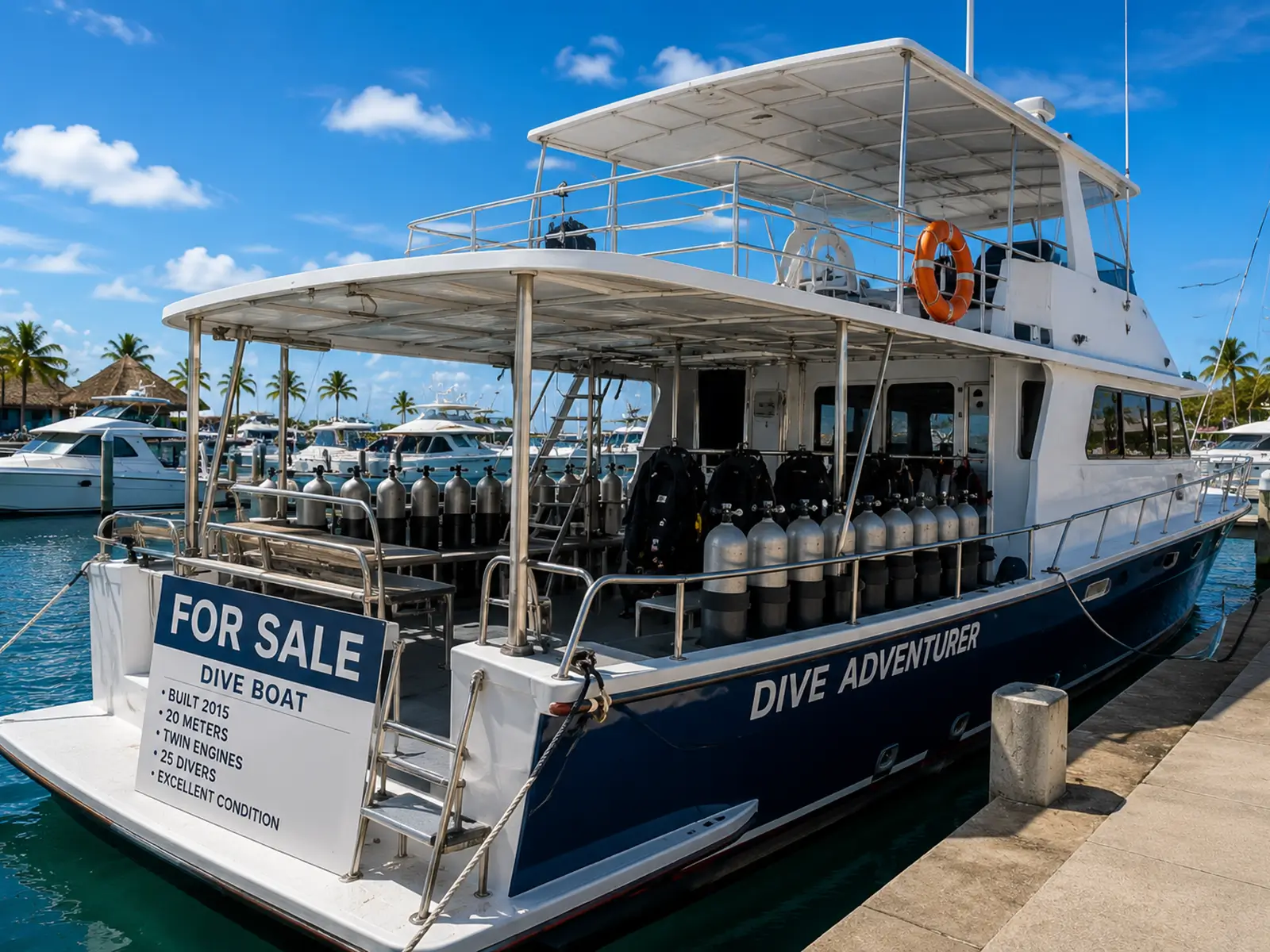
How to Buy a Dive Boat for a Scuba Business
Buying a dive boat can completely change how a scuba business operates.
A good dive boat can give access to better dive sites, increase trip capacity, improve customer experience and create new revenue opportunities. A bad boat can become expensive, unsafe, uncomfortable and difficult to operate.
A dive boat is not just a boat that can carry divers. It is a working platform for people, tanks, equipment, crew, safety systems and daily commercial use.
On "Dive Listings", buyers can compare different scuba-related opportunities, including dive centers, dive boats and liveaboards. But before buying any boat, it is important to understand whether it is truly suitable for dive operations.
If you are looking at a full business rather than only a vessel, start with "how to buy a dive center". This guide focuses specifically on buying a dive boat for commercial scuba diving.
1. Decide What Type of Dive Boat You Need
Before looking at any boat for sale, define how the boat will be used.
A dive boat for short local trips is different from a boat used for long offshore dives, technical diving, snorkeling groups or private charters.
Common dive boat types include:
- Small rigid inflatable boats
- Hard boats for day diving
- Catamarans
- Speedboats
- Purpose-built dive boats
- Converted fishing boats
- Passenger boats adapted for diving
- Larger day-trip boats with toilets and shaded areas
The right boat depends on your business model.
A small fast boat may work well for short trips with certified divers. A larger boat may be better for beginner divers, families, mixed groups and longer days at sea. A technical diving operation may need more deck space, stronger ladders and better cylinder storage.
Do not buy based only on appearance. Buy based on the trips you want to operate.
2. Check Passenger Capacity Carefully
Passenger capacity affects revenue, comfort and legal compliance.
A boat that can legally carry more people may allow higher trip revenue. But maximum passenger capacity is not always the same as comfortable dive capacity.
For dive operations, you need space for:
- Divers
- Crew
- Tanks
- BCDs and regulators
- Weight belts
- Cameras
- Dry bags
- Spare equipment
- Oxygen kit
- First aid kit
- Entry and exit movement
A boat licensed for 12 passengers may feel crowded with 12 divers, 12 tanks, full equipment and crew.
Ask:
- What is the legal passenger capacity?
- How many divers can it carry comfortably?
- Is there enough space for gear?
- Can divers move safely when fully equipped?
- Is there space for briefings?
- Is there enough shade and seating?
- Is the layout suitable for beginners?
For a dive business, comfort and workflow matter as much as the number on the certificate.
3. Look at the Deck Layout
Deck layout is one of the most important features of a dive boat.
A boat may be good for fishing or leisure use but poor for diving.
A practical dive boat should allow divers to prepare, move, enter the water and return safely.
Check for:
- Open deck space
- Seating for divers
- Tank racks
- Gear storage
- Non-slip surfaces
- Easy movement to entry point
- Safe exit area
- Space for crew to assist
- Dry storage
- Shaded area
- Clear walkways
- Low trip hazards
The deck should feel organized, not improvised.
If divers must step over tanks, bags, hoses and benches to enter the water, the layout may slow operations and increase risk.
A good dive boat makes daily work easier for staff and more comfortable for customers.
4. Entry and Exit Are Critical
Getting into the water is easy. Getting back onto the boat can be the real test.
A dive boat needs a safe, practical exit system for tired divers wearing full equipment.
Check:
- Ladder type
- Ladder angle
- Ladder strength
- Handholds
- Swim platform
- Exit height from water
- Space for crew assistance
- Suitability for beginners
- Suitability in waves
- Suitability for heavy gear
A weak or narrow ladder can create serious problems.
For recreational diving, the ladder must work for different body sizes and experience levels. For technical diving, it must handle heavier equipment. For snorkeling and beginner programs, it should be simple and confidence-building.
Before buying, test the ladder in real conditions if possible.
A beautiful boat with poor exit access is not a good dive boat.
 |
5. Tank Storage Must Be Secure
Scuba tanks are heavy and must be stored safely.
Poor tank storage can damage equipment, slow down operations and create safety risks.
Look for:
- Proper tank racks
- Secure cylinder straps
- Easy access to tanks
- Enough space for full and empty tanks
- Safe loading and unloading
- Weight distribution
- Storage for stage cylinders, if needed
- Separation from passenger movement areas
A boat that carries tanks loosely on the deck is not ideal for professional operations.
Tank storage should be built into the boat layout or professionally installed.
Also consider how tanks are moved on and off the boat every day. If loading is difficult, it can create staff fatigue and slow turnaround between trips.
6. Engines and Fuel Costs Matter
Engines are one of the biggest financial risks when buying a dive boat.
A boat may look good in photos, but engine problems can become expensive quickly.
Ask for:
- Engine make and model
- Engine age
- Engine hours
- Service history
- Fuel consumption
- Recent repairs
- Spare parts availability
- Local mechanic support
- Warranty, if any
- Any known issues
Also think about the type of engine setup.
A single engine may be cheaper to run but creates more dependency. Twin engines may add safety and redundancy but increase service and fuel costs.
Fuel consumption is especially important. A boat that uses too much fuel may reduce profit on every trip.
Before buying, calculate approximate fuel cost per trip and compare it with expected revenue.
For a deeper cost view, read "dive boat operating costs".
7. Check the Hull and Build Quality
The hull condition affects safety, performance and future repair costs.
A proper inspection should look at:
- Hull material
- Structural condition
- Cracks or damage
- Previous repairs
- Signs of impact
- Corrosion
- Osmosis, if relevant
- Deck condition
- Bilge condition
- Drainage
- Stability
- Weight distribution
A boat used commercially works harder than a private leisure boat.
It may carry heavy tanks, many passengers, daily traffic and frequent loading. That means build quality matters.
If you are not experienced, use a marine surveyor or qualified boat technician before completing the purchase.
A professional survey can save you from expensive surprises.
8. Safety Equipment Must Match Commercial Use
A dive boat must be safe for paying customers, not only legal on paper.
Check safety equipment such as:
- Life jackets
- Emergency oxygen
- First aid kit
- Fire extinguishers
- VHF radio
- GPS
- Navigation lights
- Flares or distress signals
- Bilge pumps
- Anchor and lines
- Emergency ladder or recovery method
- Tool kit
- Spare parts
- Emergency action plan
Safety requirements depend on the country, passenger capacity, distance from shore and type of operation.
Do not assume that because the boat is floating, it is ready for commercial dive trips.
For a full safety-focused guide, read "dive boat safety and compliance".
 |
9. Documents and Registration Must Be Clear
A dive boat should come with clean paperwork.
Before buying, ask for:
- Boat registration
- Ownership documents
- Commercial operating certificate, if required
- Passenger capacity certificate
- Insurance documents
- Inspection records
- Engine service records
- Mooring or marina agreement
- Tax or import documents
- Finance or loan status
- Any accident or repair history
The boat may be physically attractive, but unclear documents can make the purchase risky.
Also check whether the boat can legally be used for the type of diving business you want to run.
A boat registered for private use may need changes before it can carry paying customers. A boat licensed in one area may not automatically be approved in another.
Local professional advice is important before completing the deal.
10. Mooring, Marina and Storage
Buying the boat is only part of the decision.
You also need somewhere to keep it.
Check:
- Is a mooring included?
- Is a marina berth available?
- Can the berth transfer to the buyer?
- What are monthly or annual fees?
- Are there waiting lists?
- Is commercial use allowed?
- Is fuel available nearby?
- Is fresh water available?
- Is there secure storage?
- Is loading equipment easy?
- Are there restrictions on departure times?
A boat without secure mooring or marina access can become difficult to operate.
In some destinations, the berth or marina access may be almost as important as the boat itself.
Do not assume you can simply keep the boat where the seller currently keeps it. Confirm transfer rules before buying.
11. Comfort Affects Customer Experience
Divers remember more than the dive site.
They also remember whether the boat was comfortable, safe, organized and pleasant.
For commercial dive trips, comfort features may include:
- Shade
- Seating
- Toilet
- Fresh water shower
- Dry storage
- Easy boarding
- Stable ride
- Space for cameras
- Drinking water
- Clear briefing area
- Protection from spray
- Smooth entry and exit
Not every dive boat needs luxury features, but it should match the customer profile.
A fast basic boat may suit experienced divers on short trips. A family-friendly dive operation may need more comfort. A premium business may need a higher standard.
Customer comfort can affect reviews, repeat bookings and pricing power.
12. Match the Boat to Local Conditions
A boat that works well in one destination may not be right for another.
Before buying, consider local conditions:
- Distance to dive sites
- Sea state
- Wind patterns
- Currents
- Harbor access
- Beach launch requirements
- Fuel availability
- Weather changes
- Water depth near mooring
- Local regulations
- Passenger expectations
For example, a small fast boat may work well in calm, protected waters but be uncomfortable in rougher seas. A larger boat may be more stable but harder and more expensive to operate.
The right boat is the one that fits the local market and daily route, not only the one that looks attractive.
13. Think About Revenue Per Trip
A dive boat should support the business financially.
Before buying, estimate the economics of a normal trip.
Consider:
- Number of paying divers
- Price per diver
- Crew cost
- Fuel cost
- Marina or mooring cost
- Equipment cost
- Insurance
- Maintenance reserve
- Commission, if bookings come through partners
- Cancellation risk
- Time between trips
A boat that feels affordable may still be a poor business decision if each trip has weak margins.
A larger boat may generate more revenue per trip but also cost more to operate. A smaller boat may have lower costs but limited capacity.
The right answer depends on your market, pricing and customer demand.

14. Avoid Buying More Boat Than You Need
Many buyers are attracted to bigger boats.
But bigger is not always better.
A larger boat may bring:
- Higher fuel costs
- Higher marina fees
- More crew requirements
- More maintenance
- More insurance
- Higher repair costs
- More complex regulations
- Greater risk in low season
If your market only supports small groups, a large boat may become a burden.
Buy the boat that fits your realistic demand, not your dream version of the business.
It is better to run a right-sized boat profitably than to own an impressive boat that is half empty most of the time.
15. When a Dive Boat Is Not Enough
Sometimes buyers look at a boat and imagine it is already a business.
But a boat alone is not always a complete dive operation.
You may still need:
- Licenses
- Insurance
- Crew
- Dive equipment
- Tanks
- Compressor or filling supplier
- Booking system
- Website
- Customer source
- Marketing
- Shore base
- Storage
- Safety procedures
If you are buying only a boat, understand what else is needed to turn it into a working dive business.
If you want a larger operation with accommodation and multi-day trips, read "buy a liveaboard", because that is a different business model entirely.
Final Thoughts
Buying a dive boat is a serious business decision.
The right boat can improve customer experience, open better dive sites and create new revenue opportunities. The wrong boat can create high costs, safety concerns and operational problems.
Before buying, look beyond the photos.
Check capacity, deck layout, entry and exit, tank storage, engines, hull condition, safety equipment, documents, mooring, comfort, local conditions and trip economics.
A good dive boat is not just one that floats and looks professional.
It is one that can safely, legally and profitably support the type of scuba business you want to run.
Next Steps for Buyers
If you are comparing a full dive operation, start with "how to buy a dive center".
If you are considering a multi-day vessel business, read "buy a liveaboard".
Before calculating your budget, review "dive boat operating costs".
Before making an offer, check "dive boat safety and compliance".
If you are ready to compare opportunities, browse current "dive boats for sale" on "Dive Listings".
You can also explore more guides in our "Dive Boats & Liveaboards" section.
 |