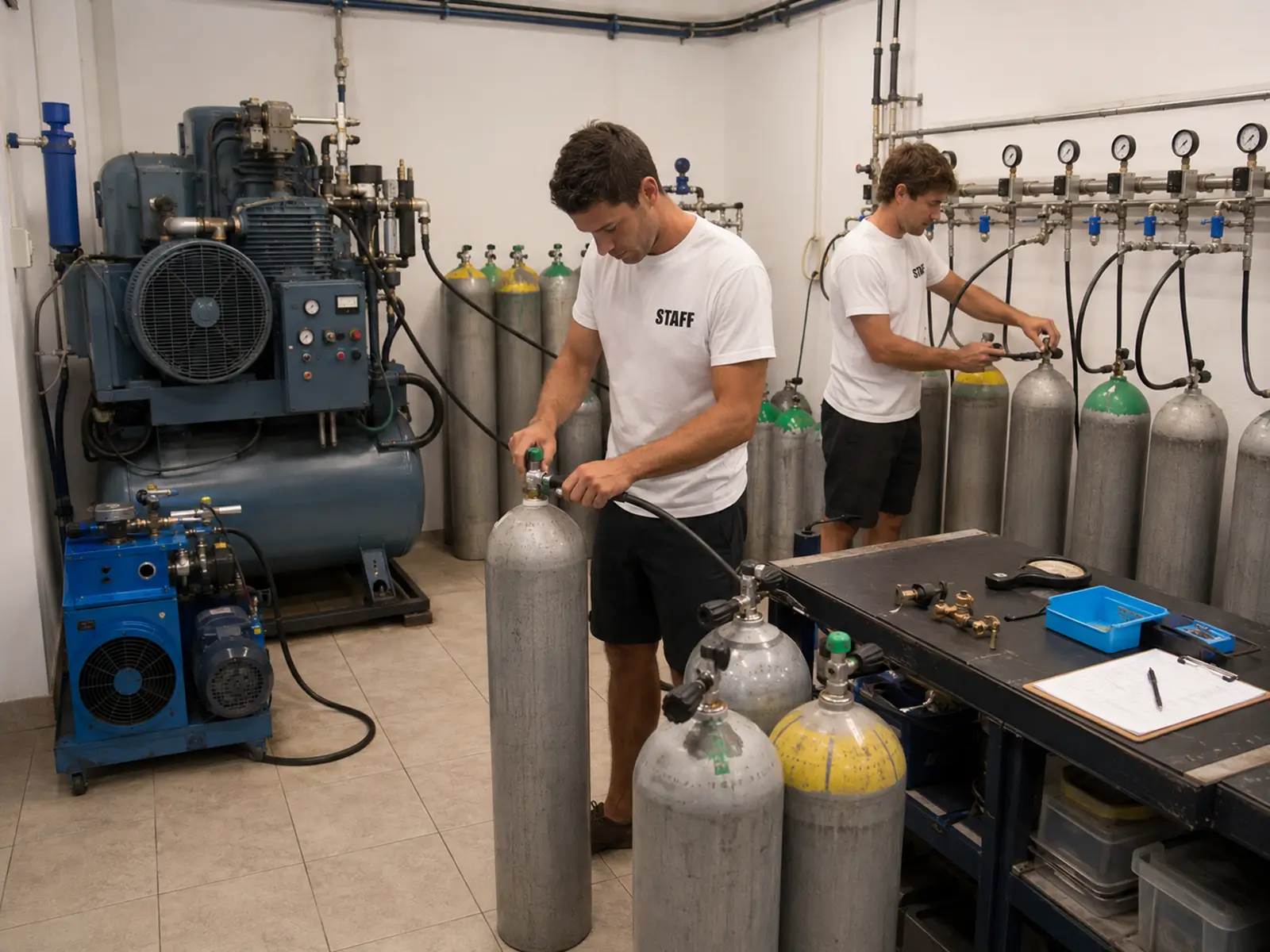
Buying Compressors and Fill Stations for Dive Businesses
A dive compressor is one of the most important pieces of equipment in many scuba businesses.
It is also one of the most serious.
A regulator, BCD or wetsuit can affect customer comfort. A compressor affects breathing gas, safety, daily operations, staff workload and business reliability.
For a dive center, a compressor and fill station can be a valuable asset. It can reduce dependence on outside suppliers, support rental tanks, enable training programs and create more control over daily logistics.
But a poorly maintained compressor can become expensive, unsafe and difficult to operate.
On "Dive Listings", buyers can compare professional dive equipment, dive centers and scuba business opportunities. This guide explains what buyers and sellers should understand before buying, selling or valuing compressors and fill stations.
If you are buying general scuba gear, start with "buy used dive equipment". This article focuses specifically on compressors, storage banks and filling systems.
1. A Compressor Is Not Ordinary Dive Equipment
A compressor should not be treated like a simple used equipment item.
It is part of the safety infrastructure of a dive business.
A compressor affects:
- Breathing air quality
- Tank filling capacity
- Daily dive scheduling
- Staff workload
- Customer safety
- Maintenance costs
- Legal compliance
- Business independence
- Emergency backup planning
A cheap used compressor can look attractive, but the real question is whether it can safely and reliably support the business.
Before buying, think of the compressor as a technical system, not just a machine.
2. Know What Is Included
Compressor listings can be confusing.
A seller may say “complete fill station”, but buyers need to know exactly what is included.
Ask for a detailed list of:
- Compressor unit
- Motor
- Filtration system
- Moisture separator
- Filling panel
- Filling whips
- Pressure gauges
- Storage banks
- Hoses
- Valves
- Electrical components
- Cooling system
- Air intake system
- Spare filters
- Spare parts
- Manuals
- Service records
- Air quality test records
A compressor alone is not the same as a complete filling system.
A buyer should understand whether the equipment is ready to install and use, or whether important parts are missing.
3. Check Compressor Capacity
Capacity is one of the first things to check.
A compressor must match the number of tanks the business needs to fill.
Important details include:
- Filling rate
- Maximum pressure
- Number of tanks filled per hour
- Daily operating volume
- Duty cycle
- Motor power
- Cooling requirements
- Suitability for commercial use
A small compressor may work for a private diver or very small operation, but may be too slow for a busy dive center.
A large compressor may be powerful, but it may require more space, more power, better ventilation and higher maintenance costs.
The right compressor is not always the biggest.
It is the one that fits the real tank-filling demand of the business.
4. Understand Air Demand
Before buying a compressor, estimate the real air demand.
A dive business should consider:
- Number of dives per day
- Number of tanks per customer
- Rental fleet size
- Course activity
- Staff tanks
- Backup tanks
- Peak season demand
- Low season demand
- Nitrox demand, if relevant
- Boat trip logistics
- Storage bank use
For example, a small center doing a few local dives per day may need a different setup than a busy training center filling dozens of tanks daily.
Buyers should not buy only for average days. They should understand peak demand too.
A compressor that cannot keep up during high season can create delays, stress and lost revenue.
 |
5. Service History Is Critical
Service history is one of the most important parts of buying a used dive compressor.
Ask for:
- Last service date
- Service provider
- Running hours
- Filter change records
- Oil change records
- Belt replacement records
- Valve service history
- Pressure test records
- Air quality test records
- Repair history
- Parts replaced
- Known issues
- Manuals and maintenance schedule
A compressor with clear service records is usually more attractive than one with no documentation.
Missing records do not automatically mean the compressor is unusable, but they increase buyer risk.
A buyer should assume that a compressor with unclear history may need inspection, servicing and possible repairs before commercial use.
6. Running Hours Matter
Compressor hours help buyers understand usage.
Ask:
- How many total hours are on the compressor?
- Are the hours documented?
- Is the hour meter working?
- How many hours per month was it used?
- Was it used commercially or privately?
- Was maintenance done according to hours or only occasionally?
A compressor with high hours can still be valuable if it has been serviced properly.
A compressor with low hours can still be risky if it has been stored badly, neglected or operated incorrectly.
Hours are only useful when combined with service history and current inspection.
7. Air Quality Records Are Essential
A dive compressor must produce breathing air that meets the required standard in the local market.
Buyers should ask for recent air quality test records.
These records may show whether the air has been tested for issues such as:
- Carbon monoxide
- Carbon dioxide
- Oil vapor
- Moisture
- Odor
- Contamination
- Oxygen content, when relevant
Rules and testing requirements vary by country, but a professional dive business should be able to show that its breathing air is tested properly.
If no air quality records exist, buyers should be careful.
A compressor may run, sound normal and fill tanks, but that does not prove the air is safe.
8. Filters and Purification System
The filtration system is a key part of compressor safety.
Buyers should check:
- Filter type
- Filter housing condition
- Filter cartridge availability
- Filter change schedule
- Moisture separation
- Drain system
- Oil separator
- Air quality monitoring
- Cost of replacement filters
- Availability of compatible cartridges
Filters are not optional extras. They are part of safe air production.
A compressor that has been operated with overdue filters may create serious air quality risk.
Before buying, calculate the ongoing cost of replacement filters and check whether they are easy to source locally.
9. Electric, Petrol or Diesel Compressor
Compressors can be powered in different ways.
Each option has advantages and challenges.
Electric compressors may be suitable for fixed dive centers with reliable power. They can be cleaner and easier to use indoors when installed correctly.
Petrol or diesel compressors may be useful in remote areas, boats or places without reliable electricity, but they require careful exhaust management and safe air intake placement.
Buyers should check:
- Power requirements
- Voltage and phase
- Fuel type
- Electrical installation needs
- Exhaust location
- Air intake location
- Noise
- Ventilation
- Local rules
- Operating cost
Never assume a compressor can simply be plugged in anywhere.
Installation must be safe and suitable for breathing air production.
10. Air Intake Location
Air intake location is extremely important.
A compressor should not draw air from a contaminated area.
Risks can include:
- Engine exhaust
- Generator fumes
- Vehicle fumes
- Boat exhaust
- Chemical storage
- Paint fumes
- Cleaning products
- Poor ventilation
- Enclosed rooms
- Cooking or gas fumes
The compressor may be mechanically good, but if the air intake is badly placed, the air can become unsafe.
When buying a compressor as part of a dive center, inspect not only the machine but also how it is installed.
A safe installation matters as much as the compressor itself.
11. Ventilation and Cooling
Compressors produce heat and need proper cooling.
Poor ventilation can reduce performance, increase wear and create safety problems.
Check:
- Room ventilation
- Airflow
- Cooling system
- Ambient temperature
- Distance from walls
- Dust or salt exposure
- Humidity
- Whether the compressor overheats
- Whether the room is suitable for long fills
In hot climates, compressor cooling is especially important.
A compressor that works well in a cool workshop may struggle in a small, hot, poorly ventilated room.
Before buying, ask how the compressor performs during peak season or long filling periods.
12. Storage Banks
Storage banks can make filling operations faster and more efficient.
They allow compressed air to be stored and used to fill tanks more quickly, especially during busy periods.
Buyers should check:
- Number of storage cylinders
- Pressure rating
- Inspection dates
- Valve condition
- Manifold condition
- Location and mounting
- Safety relief systems
- Filling procedure
- Service history
- Whether banks are included in the sale
Storage banks can add value, but only if they are safe, inspected and suitable for the system.
Old or expired storage cylinders may require testing or replacement.
Do not assume storage banks are valuable without checking their condition and certification.
 |
13. Fill Panels and Whips
The fill panel is where daily staff interaction happens.
A professional fill panel should be safe, organized and easy to use.
Check:
- Number of filling outlets
- Pressure gauges
- Valves
- Hoses
- Whips
- DIN or yoke adapters
- Bleed valves
- Condition of fittings
- Protection from damage
- Ease of use
- Safety shielding, if required
- Clear labeling
Filling tanks is repetitive work.
A poor fill panel can slow down operations and increase risk.
Staff should be able to fill tanks safely, monitor pressure clearly and handle the system without confusion.
14. Noise and Location
Compressors can be loud.
Noise can affect staff, customers, neighbors, hotels and landlords.
Before buying or installing a compressor, consider:
- Noise level
- Room location
- Operating hours
- Neighbor complaints
- Hotel or residential proximity
- Sound insulation
- Local restrictions
- Customer waiting area
- Staff comfort
A compressor in the wrong location can create practical and legal problems.
This is especially important for dive centers in tourist areas, hotels, marinas or mixed-use buildings.
A compressor may be technically good but unsuitable for the premises.
15. Compliance and Local Rules
Compressor and fill station requirements vary by country and region.
Buyers should check local rules for:
- Compressor installation
- Breathing air standards
- Air quality testing
- Pressure vessel inspections
- Storage bank certification
- Tank filling procedures
- Staff training
- Fire safety
- Ventilation
- Noise
- Electrical installation
- Insurance requirements
Do not rely on general advice from another country.
A system that is accepted in one destination may need changes somewhere else.
If buying a compressor with a full dive business, confirm whether the current setup is compliant and whether permissions transfer to the new owner.
16. Staff Training
Only trained people should operate a compressor and fill station.
Staff should understand:
- Start-up procedure
- Shutdown procedure
- Draining moisture
- Filter change intervals
- Pressure limits
- Tank inspection checks
- Safe filling speed
- Emergency shutdown
- Record keeping
- Air quality testing schedule
- What to do when something sounds or smells wrong
A compressor is not a machine that should be operated casually by anyone in the shop.
Poor operation can damage the compressor, reduce air quality and create safety risk.
A buyer should check whether staff are already trained and whether procedures are written down.
 |
17. Operating Costs
Compressors bring ongoing costs.
These may include:
- Electricity or fuel
- Oil
- Filters
- Service parts
- Labor
- Air quality tests
- Repairs
- Pressure testing
- Storage bank inspections
- Replacement hoses
- Replacement gauges
- Technician visits
- Spare parts shipping
- Downtime
A compressor can save money compared with buying air from another supplier, but only if it is used enough and maintained properly.
A low-use business may find that external filling is simpler.
A busy dive center may benefit strongly from its own filling system.
The decision depends on volume, costs and reliability.
18. Backup Plan
A compressor failure can stop daily operations.
Every dive business should have a backup plan.
This may include:
- Backup compressor
- Relationship with another filling station
- Extra storage banks
- Spare filters
- Spare parts
- Technician contact
- Emergency tank supply
- Schedule flexibility
A business that depends on one old compressor with no backup carries more risk.
Buyers should ask:
What happens if the compressor stops working during high season?
The answer matters.
19. Nitrox and Mixed Gas Considerations
Some dive businesses offer nitrox or more advanced gas services.
This adds complexity.
Buyers should check:
- Whether the compressor is suitable for the gas system
- Whether blending equipment is included
- Oxygen-clean requirements
- Analyzer availability
- Staff training
- Documentation
- Local rules
- Insurance coverage
- Demand for nitrox or technical diving
- Cost of oxygen supply
Do not assume that a standard air compressor setup is ready for nitrox or technical gas services.
Gas blending should only be handled with proper training, equipment and procedures.
If nitrox is part of the business model, review the system carefully with a qualified professional.
20. Buying a Compressor With a Dive Center
When buying a full dive center, the compressor may be one of the most important assets.
Buyers should ask:
- Is the compressor included in the sale?
- Who owns it?
- Is it financed or leased?
- Are service records available?
- Are air tests current?
- Are storage banks included?
- Is the fill station compliant?
- Are staff trained?
- Are spare filters included?
- Are local technicians available?
- What investment is needed soon?
A working compressor can support business value.
A neglected compressor can reduce value because the buyer may face immediate service, testing or replacement costs.
For full business valuation, this connects with "equipment and asset value".
21. Selling a Compressor or Fill Station
Sellers should prepare a compressor listing carefully.
A strong listing should include:
- Brand
- Model
- Year
- Running hours
- Filling rate
- Maximum pressure
- Power type
- Service history
- Filter system
- Air quality records
- Included fill panel
- Included storage banks
- Spare parts
- Manuals
- Photos
- Known issues
- Location
- Transport details
Do not simply write “compressor for sale”.
Buyers need technical details and documentation before they can judge value.
For general selling advice, read "sell dive equipment".
22. Red Flags
Be careful when:
- No service records exist
- No air quality tests are available
- The seller cannot explain the system
- Running hours are unknown
- Filters are overdue
- Oil leaks are visible
- The compressor overheats
- The air smells unusual
- Spare parts are hard to source
- Storage banks are expired
- The fill panel is poorly assembled
- Electrical installation looks improvised
- Air intake is near exhaust fumes
- The price seems too low for the system
- The seller refuses inspection
A compressor is not the place to take unnecessary risks.
When in doubt, get a qualified technician to inspect it before purchase.
Final Thoughts
Compressors and fill stations are critical assets in many dive businesses.
They can give a dive center independence, improve daily logistics, support rental tanks and create operational value.
But they also carry serious responsibility.
Before buying, check the compressor model, capacity, running hours, service history, air quality records, filters, storage banks, fill panel, installation, ventilation, air intake, compliance, staff training and operating costs.
A compressor that runs is not automatically safe.
A valuable compressor system is one that is properly installed, documented, maintained and suitable for the business volume.
For buyers, careful inspection can prevent expensive and dangerous mistakes.
For sellers, clear documentation and honest technical details can make the equipment much easier to sell.
Next Steps for Buyers and Sellers
If you are buying general scuba gear, start with "buy used dive equipment".
If you are preparing equipment for sale, read "sell dive equipment".
To understand how rental gear affects business value, review "dive equipment rental fleet".
If you are buying a full scuba operation, read "how to buy a dive center".
If you are ready to compare opportunities, browse current "dive equipment for sale" on "Dive Listings".
You can also explore more guides in our "Dive Equipment Business" section.