How Dive Centers Can Get More Customers
Every dive center needs customers.
A beautiful location, good equipment and experienced instructors are important, but they are not enough if people do not find the business, trust it and book.
Many dive centers rely too much on one source of customers. Some depend only on walk-ins. Some depend only on hotels. Some depend only on Google. Some depend only on repeat customers or one travel agency.
That can work for a while, but it creates risk.
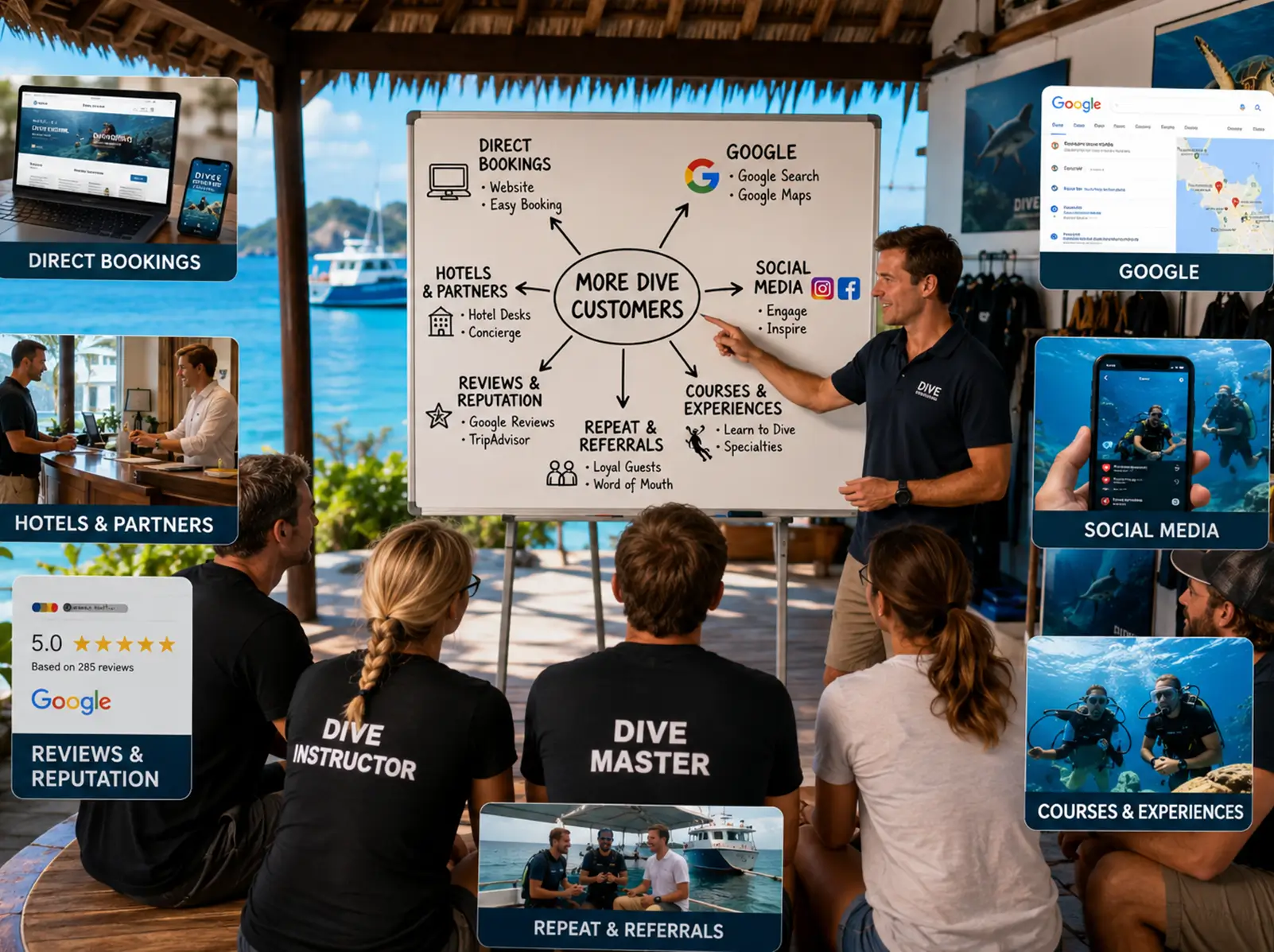
A stronger dive business usually has several customer channels working together: website, Google Maps, reviews, local partnerships, social media, email follow-up, repeat divers, courses, direct bookings and good customer service.
On "Dive Listings", buyers can compare dive businesses for sale, but understanding how a dive center gets customers is also important before buying or growing one.
If you are running a dive operation, this guide gives you a practical overview of the main ways to attract more customers.
1. Start With a Clear Offer
Before spending money on marketing, a dive center needs a clear offer.
Customers should quickly understand what the business provides.
This may include:
- Try dives
- Guided dives
- Beginner courses
- Advanced courses
- Private guiding
- Snorkeling trips
- Boat dives
- Shore dives
- Family activities
- Technical diving
- Freediving
- Equipment rental
- Dive packages
A common mistake is showing too many options without making the main offer clear.
A tourist visiting for a few days wants to know:
- Can I dive here?
- Is it suitable for beginners?
- What does it cost?
- What is included?
- How long does it take?
- Where do we meet?
- Can I book easily?
- Is the dive center safe and trusted?
A clear offer helps customers make decisions faster.
If people are confused, they often do not ask more questions. They simply leave the website or choose another center.
2. Build a Website That Converts
A dive center website should not only look attractive.
It should turn visitors into enquiries and bookings.
A good website should clearly show:
- Main activities
- Prices or starting prices
- Location
- Dive sites
- Customer reviews
- Photos
- Certification options
- Booking button
- Contact options
- Languages spoken
- What is included
- Safety information
- Frequently asked questions
The website should work well on mobile.
Many tourists search from their phones while already in the destination. If the site is slow, confusing or difficult to book from, the dive center may lose customers.
The best website is not always the most complex. It is the one that answers customer questions and makes booking easy.
For deeper visibility in Google, read "local SEO for dive centers".
3. Make Booking Easy
Marketing does not end when someone wants to book.
If the booking process is difficult, customers may disappear.
A dive center should make it easy to:
- Ask a question
- Choose an activity
- Check availability
- Understand the price
- Pay a deposit or full amount
- Submit equipment sizes
- Complete forms
- Receive confirmation
- Know where and when to arrive
Customers should not need to send five messages just to understand basic information.
A smooth booking system can increase conversion without bringing any extra website traffic.
This connects closely with "booking and guest flow", because better customer management can turn more enquiries into real bookings.
4. Improve Google Visibility
Many dive customers start with Google.
They may search for phrases like:
- scuba diving near me
- dive center near me
- try dive in [destination]
- PADI course in [destination]
- scuba diving [island]
- best dive center [destination]
- snorkeling and diving [destination]
A dive center should appear when people search for local diving activities.
This means working on:
- Website SEO
- Google Business Profile
- Google Maps visibility
- Local keywords
- Reviews
- Photos
- Location pages
- Clear service pages
- Fast mobile experience
Google visibility is especially important because customers searching locally may already be close to booking.
They are not only dreaming about diving someday. They may want to book today, tomorrow or this week.
That is why "local SEO for dive centers" deserves its own detailed guide.
5. Take Google Business Profile Seriously
For many dive centers, the Google Business Profile is almost as important as the website.
Customers use it to check:
- Location
- Opening hours
- Reviews
- Photos
- Phone number
- Website link
- Directions
- Recent updates
- Questions and answers
A weak or outdated profile can reduce trust.
A strong profile should include:
- Correct business name
- Accurate opening hours
- Good photos
- Clear categories
- Updated contact details
- Responses to reviews
- Useful business description
- Links to booking or website
- Regular updates when needed
Photos are especially important for dive centers.
Customers want to see the team, equipment, boat, shop, dive sites and general atmosphere.
A good Google profile can help convert searchers into customers before they even open the website.
6. Reviews Can Drive Bookings
Reviews are one of the strongest marketing tools for a dive center.
Scuba diving involves trust. Customers want to know that the staff are safe, friendly, professional and organized.
Good reviews can show:
- Safety
- Friendly instructors
- Good equipment
- Clear briefings
- Beginner support
- Professional organization
- Great dive sites
- Good value
- Strong customer service
A dive center should actively ask happy customers for reviews.
This should be done politely and naturally after a good experience.
For example:
“Thank you for diving with us today. Reviews really help our dive center, and we would be grateful if you could share your experience.”
Do not pressure customers. Just make it easy.
Reviews also help buyers evaluate a business. A dive center with strong, consistent reviews usually has better trust and stronger marketing value.
For a deeper article, read "repeat divers and reviews".
7. Use Photos and Videos Properly
Diving is visual.
Good photos and videos can help a dive center sell the experience before the customer arrives.
Useful content includes:
- Happy customers
- Dive briefings
- Boats
- Equipment setup
- Underwater life
- Dive sites
- Shore entry points
- Instructor moments
- Course photos
- Snorkeling trips
- Behind-the-scenes preparation
The goal is not only to show beautiful underwater images.
Customers also want to see that the business is real, active, clean, safe and welcoming.
Avoid using only generic stock-style underwater photos. Real photos from the actual operation usually build more trust.
Strong visual content can support the website, Google profile, social media and hotel partnerships.
8. Build Hotel and Resort Partnerships
In many tourist destinations, hotels and resorts can be a major source of customers.
Guests often ask reception, concierge, tour desks or apartment managers what they should do during their stay.
A dive center can build partnerships with:
- Hotels
- Resorts
- Apartment complexes
- Hostels
- Guesthouses
- Concierge desks
- Tour desks
- Travel agencies
- Activity sellers
- Local guides
Partnerships work best when they are reliable and easy for the partner.
The dive center should provide:
- Clear prices
- Simple booking process
- Professional materials
- Fast confirmation
- Good customer feedback
- Commission structure, if used
- Emergency contact
- Pickup details, if available
This channel is important enough for its own article: "hotel and resort partnerships".
9. Do Not Depend Only on Walk-Ins
Walk-ins can be valuable, especially in busy tourist areas.
But relying only on walk-ins can be risky.
Walk-in demand may depend on:
- Foot traffic
- Weather
- Hotel occupancy
- Street visibility
- Nearby competition
- Season
- Signage
- Location
A dive center in a great location may receive strong walk-in traffic, but the business should still build other channels.
Direct website bookings, Google visibility, hotel partnerships and repeat customers can make the business more stable.
Walk-ins are good, but they should be one part of the customer mix, not the entire marketing strategy.
10. Create Packages That Are Easy to Understand
Packages can help customers choose faster.
Instead of listing only individual dives and courses, a dive center can create simple offers such as:
- Beginner try dive
- Two-dive certified package
- Family snorkeling trip
- Three-day dive package
- Open Water course package
- Refresher plus guided dive
- Private guide option
- Boat dive package
- Local resident package
Packages should be clear and not too complicated.
Each package should explain:
- Who it is for
- What is included
- Duration
- Price
- Required experience
- Equipment included or not
- Meeting point
- Booking process
Clear packages reduce questions and help customers compare options.
A confused customer often delays booking.
11. Use Social Media for Trust, Not Only Likes
Social media can help a dive center, but it should not be the only marketing strategy.
The goal is not only to get likes.
The goal is to build trust and stay visible.
Useful social media content includes:
- Daily dive photos
- Customer moments
- Short videos
- Instructor introductions
- Marine life highlights
- Course completions
- Weather and visibility updates
- Behind-the-scenes content
- Safety culture
- Dive site explanations
- Last-minute availability
Social media is especially useful when it supports other channels.
For example, a customer may find the dive center on Google, then check Instagram to see if the business looks active and professional.
An active, real social presence can increase confidence.
12. Sell Courses, Not Only Fun Dives
Courses can be an important growth channel for dive centers.
A customer who starts with a try dive may later book:
- Open Water course
- Advanced course
- Rescue course
- Specialty courses
- Refresher session
- Private coaching
- Continuing education
Dive centers should not be pushy, but they should explain the next step clearly.
After a good first dive, a customer may not know what is possible next.
Staff can say:
“You did really well today. If you want to continue, the next step would be the Open Water course.”
Courses can increase customer value and create longer relationships.
They also help fill schedules outside peak fun-dive demand.
13. Turn Good Service Into Repeat Business
A customer who has already trusted the dive center is easier to convert again than a completely new customer.
Repeat business may come from:
- Returning tourists
- Local residents
- Course students
- Certified divers
- Families
- Dive clubs
- Previous private guiding customers
- Customers who want to continue training
To encourage repeat bookings, the dive center should:
- Keep customer records
- Follow up after dives
- Offer the next logical activity
- Remember equipment sizes
- Send useful updates
- Invite customers back
- Ask for reviews
- Build a friendly relationship
Repeat customers can reduce marketing pressure because the business does not need to find every customer from zero.
This will be covered more deeply in "repeat divers and reviews".
14. Work With Local Communities
Not every customer is a tourist.
In some destinations, local residents, expats and long-stay visitors can support the business, especially during quieter months.
Local marketing may include:
- Resident discounts
- Weekend dive groups
- Local dive club events
- Refresher sessions
- Equipment service offers
- Beach cleanups
- Specialty courses
- Kids or family programs
- Partnerships with local schools or clubs
A strong local base can make a dive center more stable.
This is especially useful in destinations with seasonality, where tourist numbers change during the year.
Local customers may not replace tourism, but they can help smooth demand.
15. Track Where Customers Come From
A dive center should know which marketing channels work.
Ask customers how they found the business.
Possible sources include:
- Google search
- Google Maps
- Hotel recommendation
- Friend referral
- Social media
- Previous visit
- Walk-in
- Travel agency
- Dive club
- Online marketplace
- Paid ads
Tracking does not need to be complicated.
Even a simple note in the booking system can help.
Over time, the owner can see which channels bring serious customers, which bring price shoppers and which bring repeat business.
Marketing becomes easier when the business knows what is actually working.
16. Improve Conversion Before Spending More
Many dive centers try to get more traffic before fixing conversion.
But sometimes the problem is not traffic. The problem is that customers do not book after finding the business.
Before spending more on ads, check:
- Is the website clear?
- Is there a strong booking button?
- Are prices easy to understand?
- Are reviews visible?
- Are photos professional?
- Is the Google profile updated?
- Are enquiries answered quickly?
- Is the booking process simple?
- Are staff friendly on first contact?
- Are packages easy to understand?
- Are cancellation rules clear?
Improving conversion can increase bookings without increasing marketing spend.
More traffic is useful only when the business is ready to turn that traffic into customers.
17. Use Paid Ads Carefully
Paid ads can work for dive centers, but they should be used carefully.
Advertising may help promote:
- Try dives
- Courses
- Seasonal offers
- New dive packages
- Private guiding
- Local resident offers
- Last-minute availability
- Special trips
But ads can waste money if the website is weak, reviews are poor or the offer is unclear.
Before paying for traffic, make sure:
- The landing page is clear
- The offer is specific
- Booking is easy
- Reviews build trust
- Tracking is in place
- The price and activity match the audience
- Staff can respond quickly to enquiries
Paid ads should support a strong marketing system, not replace it.
18. Build Trust Before Asking for the Booking
Diving is a trust-based activity.
Customers want to feel safe before they pay.
A dive center can build trust by showing:
- Instructor experience
- Safety procedures
- Customer reviews
- Real photos
- Clear equipment standards
- Good communication
- Honest dive descriptions
- Beginner-friendly explanations
- Transparent prices
- Professional response times
Trust is especially important for beginners.
Someone booking a try dive may feel excited and nervous at the same time. The business should reduce fear, not add confusion.
A customer who trusts the dive center is more likely to book, spend more and recommend the business.
19. What Buyers Should Check
If you are buying a dive center, marketing is part of business value.
Ask the seller:
- Where do customers come from?
- How many bookings come from Google?
- How many come from hotels?
- How many are direct bookings?
- How many are repeat customers?
- Does the website convert?
- Is Google Business Profile controlled by the business?
- Are reviews strong and recent?
- Are social accounts active?
- Are partnerships written or informal?
- Does the business have customer records?
- Is there an email list?
- Are booking sources tracked?
- Does marketing depend only on the owner?
A dive center with several customer channels is usually safer than one relying on only one source.
Strong marketing systems can increase value because they help the business continue after sale.
20. Build a Marketing System, Not Random Posts
Marketing should not be random.
A strong dive center marketing system includes:
- Clear offers
- Professional website
- Google visibility
- Updated Google Business Profile
- Good reviews
- Easy booking
- Strong photos
- Hotel partnerships
- Repeat customer follow-up
- Local resident activity
- Simple tracking
- Consistent communication
The goal is not to do everything perfectly.
The goal is to create a reliable flow of customers from several sources.
A dive center that depends only on luck, walk-ins or one hotel partner is more vulnerable.
A dive center with multiple channels has more control.
Final Thoughts
Getting more dive customers is not about one trick.
It is about building trust, visibility and a clear path from discovery to booking.
A successful dive center usually combines a strong website, Google visibility, updated Google Business Profile, good reviews, simple packages, easy booking, hotel partnerships, social media activity, repeat customer follow-up and strong daily service.
The best marketing starts with the customer.
Can they find you? Do they trust you? Do they understand your offer? Can they book easily? Will they recommend you after the dive?
For owners, improving marketing can increase revenue and reduce dependence on one customer source.
For buyers, customer acquisition is one of the most important parts of evaluating a dive business.
A dive center with reliable customer channels is usually stronger, safer and more valuable than one waiting for people to walk through the door.
Next Steps for Dive Business Owners
To improve Google and Maps visibility, read "local SEO for dive centers".
To build offline referral channels, review "hotel and resort partnerships".
To increase repeat bookings and reputation, read "repeat divers and reviews".
To improve the customer journey after someone enquires, read "booking and guest flow".
If you are ready to compare real opportunities, browse current "dive centers for sale" on "Dive Listings".
You can also explore more guides in our "Marketing & Growth for Dive Businesses" section.