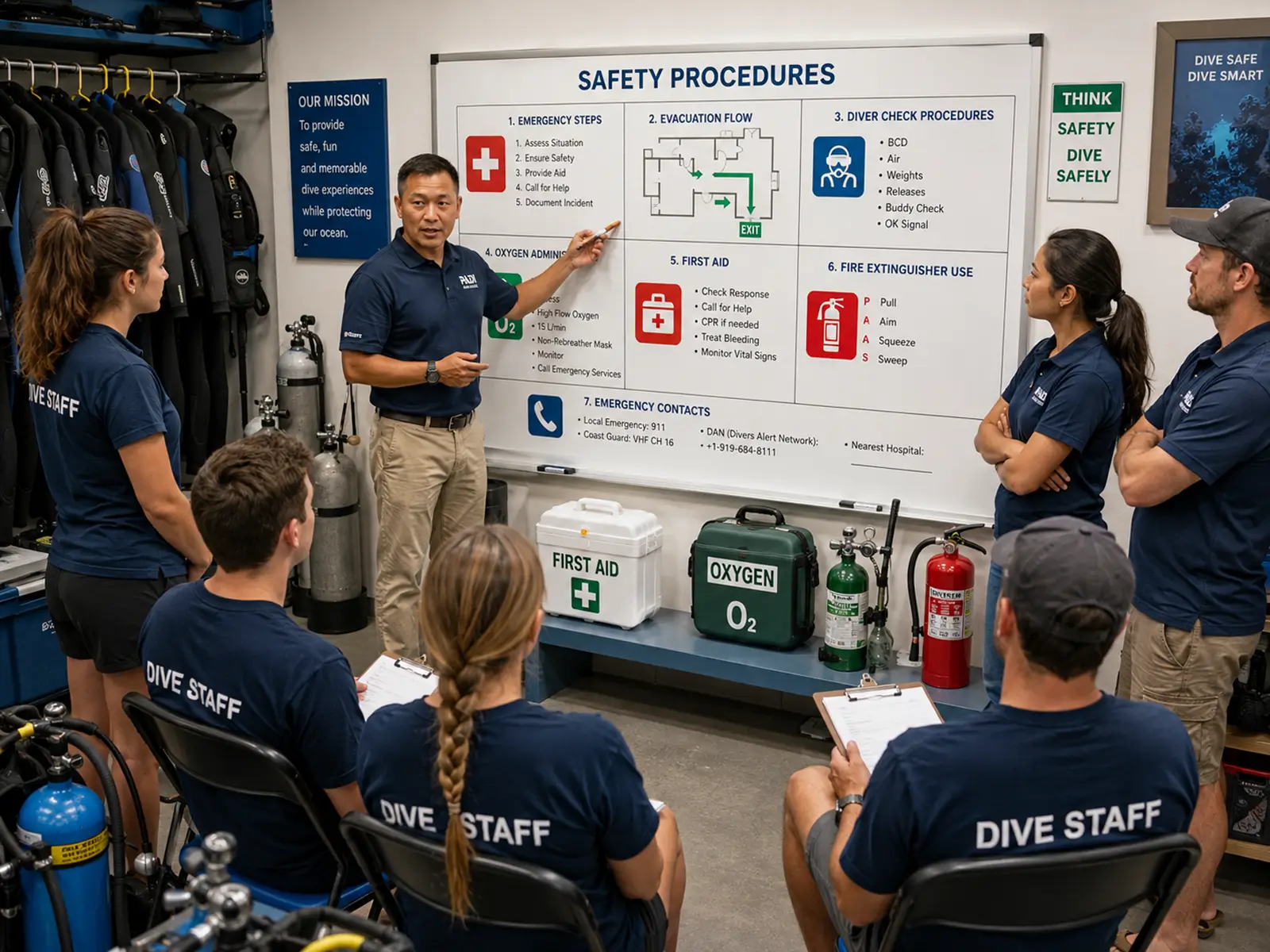
Dive Center Safety Procedures and Risk Management
Safety is one of the most important parts of running a dive center.
Customers may choose a dive center because of location, price, reviews or friendly staff, but they stay calm and confident when the operation feels safe, organized and professional.
A good safety system is not only about reacting when something goes wrong. It is about reducing the chance of problems before they happen.
This includes customer screening, equipment checks, dive planning, staff training, emergency oxygen, first aid, weather decisions, clear briefings, incident records and a written emergency action plan.
On "Dive Listings", buyers can compare dive centers and scuba businesses for sale, but safety procedures are one of the most important things to review before buying or operating any dive business.
If you want the broader daily workflow, start with "run a dive center". This article focuses specifically on safety procedures and risk management.
1. Safety Starts Before the Dive Day
Good safety begins before the customer enters the water.
Many problems can be reduced during the booking and check-in process.
A dive center should collect and review:
- Certification level
- Last dive date
- Number of logged dives
- Medical form
- Comfort level
- Swimming ability
- Equipment needs
- Language preference
- Emergency contact
- Any special concerns
This helps the team decide whether the customer is suitable for the planned activity.
For example, a certified diver who has not dived for many years may need a refresher or easier dive. A nervous beginner may need more time and a smaller group. A customer with a medical concern may need clearance before participating.
Safety should not be rushed during morning check-in.
For more detail on this part of the customer journey, read "booking and guest flow".
2. Customer Screening Must Be Clear
A dive center should have a clear process for screening customers.
This does not mean making the experience difficult. It means making sure the right customers join the right activity.
Screening should consider:
- Age requirements
- Certification requirements
- Medical requirements
- Recent dive experience
- Fitness and comfort
- Ability to understand instructions
- Local dive conditions
- Weather and sea state
- Course prerequisites
- Equipment suitability
The staff should be comfortable saying no, changing the plan or recommending another activity when needed.
A short-term sale is never worth a serious safety problem.
Professional operators protect customers by matching them to appropriate dives.
3. Staff Roles Should Be Defined
Safety becomes weaker when staff do not know who is responsible for what.
Before each activity, the team should know:
- Who is leading the dive
- Who is assisting
- Who is responsible for the boat or transport
- Who checks equipment
- Who carries emergency oxygen
- Who manages customer records
- Who makes the final weather decision
- Who contacts emergency services if needed
- Who stays with the group if there is a problem
This does not need to be complicated, but it must be clear.
In a small dive center, one person may handle several roles. In a larger operation, responsibilities may be shared.
Either way, safety depends on everyone understanding the plan.
For the people side of the business, read "staff and instructors".
4. Written Procedures Reduce Confusion
Many dive centers operate safely because the owner or senior instructor knows what to do.
But if everything is stored only in one person’s head, the business is vulnerable.
Written safety procedures help the whole team act consistently.
Useful written procedures may include:
- Daily opening safety checks
- Customer screening process
- Equipment issue process
- Dive briefing format
- Boat loading procedure
- Shore entry procedure
- Diver count procedure
- Lost diver procedure
- Emergency oxygen use
- First aid response
- Weather cancellation process
- Incident reporting
- Equipment removal from service
- Emergency contact process
Written procedures do not replace professional judgment.
They give the team a shared starting point, especially during busy days, staff changes or stressful situations.

5. Equipment Checks Must Be Routine
Equipment safety depends on routine checks, not luck.
Rental equipment should be checked before use, after use and when customers report problems.
Important checks include:
- Regulator function
- Hose condition
- SPG function
- BCD inflation and deflation
- Dump valves
- Weight systems
- Tank pressure
- Tank inspection status
- Valve condition
- Mask and fin straps
- Dive computer battery
- Exposure suit condition
Any questionable equipment should be removed from service until checked properly.
A good rule is simple:
If staff would not be comfortable using the equipment themselves, it should not be given to a customer.
Rental equipment safety is closely connected with "dive equipment rental fleet".
6. Emergency Oxygen Must Be Ready
Emergency oxygen is one of the most important safety items in a dive center.
It should be available, accessible and ready to use.
The team should know:
- Where the oxygen kit is stored
- How much oxygen is available
- Whether the cylinder is full
- How to operate the delivery system
- Which masks or valves are included
- Who is trained to use it
- How to refill it
- How to record usage
- When it was last checked
Emergency oxygen should not be hidden behind boxes, locked away without access or discovered empty when needed.
The dive center should check oxygen readiness regularly, especially before boat trips, remote shore dives or busy operating days.
7. First Aid Kit and Medical Planning
A dive center should have a complete and maintained first aid kit.
It should also have a clear medical response plan.
Staff should know:
- Where the first aid kit is located
- Who checks and restocks it
- Which staff are first aid trained
- Where the nearest medical clinic is
- Where the nearest hospital is
- Where the nearest decompression chamber is
- How to contact emergency services
- How to manage transport in an emergency
- How to record the incident
The first aid kit should match the type of activities offered.
A center doing remote boat dives or liveaboard-style trips needs a more complete plan than a small pool-based training operation.
8. Dive Briefings Should Be Consistent
A dive briefing is not just a formality.
It is one of the main tools for preventing problems underwater.
A good briefing should cover:
- Dive site overview
- Entry and exit
- Maximum depth
- Expected dive time
- Current and visibility
- Marine life or hazards
- Buddy system
- Signals
- Air checks
- Turn pressure
- Lost buddy procedure
- Emergency procedure
- Boat or shore return plan
- Environmental rules
The briefing should match the group.
Beginners need simple, calm explanations. Certified divers need clear site and safety information. Mixed groups may need extra care.
A rushed briefing can create confusion.
A clear briefing creates confidence.
 |
9. Diver Counts Are Essential
One of the most basic safety procedures is knowing exactly who is in the water and who is back.
This sounds simple, but it must be managed carefully.
A dive center should have a reliable system for:
- Pre-dive roll call
- Confirming buddy pairs
- Counting divers entering the water
- Counting divers exiting the water
- Checking customers back on the boat or shore
- Recording any change in group plan
- Confirming all divers before departure
The system should not rely only on memory.
On boat dives, this is especially important. But shore dives also need clear group control, especially in busy or low-visibility conditions.
A missing diver situation is serious. Good counting procedures help prevent it.
10. Lost Diver Procedure
Every dive center should have a lost diver procedure.
Staff should know what to do if a diver or buddy team does not return as expected.
A procedure may include:
- Time check
- Surface search
- Bubble search, where appropriate
- Contacting boat or shore team
- Alerting emergency services
- Activating emergency oxygen and first aid readiness
- Keeping the rest of the group safe
- Recording the timeline
- Coordinating with local rescue services
The exact procedure depends on the destination, dive type and local regulations.
The important point is that staff should not be improvising from zero during an emergency.
They should already know the first steps.
11. Weather and Go / No-Go Decisions
Weather decisions are a major part of dive center safety.
The business should have a clear process for deciding whether to dive, change site, delay or cancel.
Factors may include:
- Wind
- Waves
- Swell
- Current
- Visibility
- Rain
- Storm risk
- Boat safety
- Shore entry safety
- Diver experience level
- Alternative dive sites
- Staff judgment
A dive may be acceptable for experienced local divers but unsuitable for beginners or nervous customers.
The decision should consider the actual group, not only the dive site.
Good operators do not force a dive to protect short-term revenue.
Customers may be disappointed by a cancellation, but they usually respect a professional safety decision when it is explained clearly.
12. Emergency Action Plan
A dive center should have a written emergency action plan.
This plan should be easy for staff to find and understand.
It may include:
- Emergency phone numbers
- Nearest medical center
- Nearest hospital
- Nearest decompression chamber
- Local rescue services
- Coast guard or maritime rescue contacts
- Emergency transport options
- Oxygen location
- First aid kit location
- Staff responsibilities
- Incident reporting process
- Communication plan
- Customer care process after an incident
The plan should be reviewed regularly.
If phone numbers, staff roles, dive sites or local emergency services change, the plan must be updated.
A printed plan in the dive center and a digital copy for key staff can both be useful.
 |
13. Incident Reporting
Incidents and near misses should be recorded.
This does not mean creating fear or blame. It means learning from what happened.
Record details such as:
- Date and time
- Customer name, where appropriate
- Staff involved
- Dive site
- Conditions
- What happened
- Actions taken
- Equipment involved
- Medical response
- Witnesses
- Follow-up actions
- Preventive changes
Near misses are especially useful.
For example, a lost weight pocket, low-air situation, late diver return or equipment issue may not become a serious incident, but it can reveal a weakness in the system.
A professional dive center learns from small problems before they become big ones.
14. Equipment Problems Should Be Tracked
When equipment fails or feels questionable, it should be recorded.
This applies to:
- Regulators
- BCDs
- Tanks
- Valves
- Dive computers
- Masks
- Fins
- Weight systems
- Boats
- Compressors
- Vehicles
A simple repair log can show:
- Item number
- Problem reported
- Date removed from service
- Person responsible
- Repair completed
- Date returned to service
- Notes
Without tracking, broken equipment can accidentally return to use.
A clear out-of-service system protects customers and staff.
15. Compressor and Air Quality Safety
For centers with their own compressor or fill station, air safety is critical.
The business should manage:
- Compressor service schedule
- Filter changes
- Air quality testing
- Fill station procedures
- Staff training
- Tank inspection checks
- Ventilation
- Air intake location
- Emergency shutdown
- Fill logs, where used
A compressor that fills tanks is not automatically producing safe breathing air.
Air quality, filter condition and correct operation matter.
For a detailed article on this topic, read "compressors and fill stations".
16. Boat and Transport Safety
If the dive center uses boats or vehicles, safety procedures should include transport.
For boats, check:
- Passenger count
- Safety equipment
- Emergency oxygen
- First aid kit
- Radio or communication
- Fuel
- Weather decision process
- Entry and exit procedures
- Diver recall method
- Emergency return plan
For vehicles, check:
- Driver responsibility
- Passenger count
- Equipment loading
- Tank security
- Pickup points
- Road safety
- Emergency contacts
Transport is part of the dive operation.
A safe dive can still be damaged by poor boat or vehicle procedures.
For boat-specific details, read "dive boat safety and compliance".
 |
17. Environmental Safety and Responsible Diving
Safety also includes protecting the dive environment.
Dive centers should brief customers on:
- Buoyancy control
- No touching marine life
- No standing on coral
- Proper finning techniques
- Safe distance from animals
- No collecting souvenirs
- Waste management
- Reef-safe behavior
- Local marine park rules
Environmental damage can harm the destination, business reputation and long-term market value.
Responsible diving should be part of normal operations, not an optional extra.
A good dive center protects both customers and the underwater environment.
18. Staff Training and Refreshers
Safety procedures only work if staff know them.
Training should not happen once and then be forgotten.
Dive centers should review:
- Emergency oxygen use
- First aid response
- Lost diver procedure
- Customer screening
- Equipment checks
- Boat emergency process
- Weather decision process
- Incident reporting
- Emergency contact plan
- Compressor procedures, if relevant
Short refreshers can be useful before high season, after hiring new staff or after any incident.
A team that practices procedures is more likely to respond calmly when needed.
19. Safety Culture Matters
Safety culture is the attitude behind the procedures.
A dive center has a strong safety culture when staff feel comfortable speaking up.
For example, staff should be able to say:
- The conditions are not suitable
- This customer needs an easier dive
- This equipment should not be used
- We need more time
- The group is too large
- The briefing was not clear enough
- The boat should not leave yet
A weak safety culture appears when staff feel pressured to stay quiet, rush, ignore problems or prioritize sales over safety.
Procedures are important, but culture decides whether people actually follow them.
20. Safety Procedures Affect Business Value
For buyers, safety procedures are part of business value.
A dive center is stronger when it has:
- Written procedures
- Trained staff
- Maintained emergency oxygen
- Complete first aid kits
- Clear customer screening
- Good equipment logs
- Incident records
- Weather decision process
- Emergency action plan
- Transferable systems
A dive center is riskier when safety depends only on the current owner’s experience.
If the buyer cannot see how safety is managed, they should ask more questions.
A professional safety system makes the business easier to operate, easier to transfer and more trustworthy for customers.
21. What Buyers Should Ask Before Purchasing
Before buying a dive center, ask:
- Are safety procedures written down?
- Who makes final safety decisions?
- Is emergency oxygen available and checked?
- Are first aid kits complete?
- Are staff trained in first aid and oxygen use?
- Is there an emergency action plan?
- Where is the nearest decompression chamber?
- Are incidents and near misses recorded?
- How are equipment problems tracked?
- How are weather decisions made?
- What is the lost diver procedure?
- Are briefings consistent?
- Are compressor and air quality records available?
- Are boat safety documents current, if relevant?
Good answers show that safety is managed professionally.
Vague answers may indicate that the business relies too heavily on habit, memory or informal practice.
Final Thoughts
Dive center safety procedures protect customers, staff and the business itself.
A professional operation should not rely on luck or individual memory. It should have clear systems for customer screening, equipment checks, dive briefings, emergency oxygen, first aid, weather decisions, lost diver response, incident reporting, compressor safety and emergency planning.
Safety does not need to make the customer experience heavy or complicated.
When done well, safety makes the experience feel calm, organized and trustworthy.
For owners, strong procedures reduce stress and risk.
For buyers, safety systems show whether the dive center is ready to operate under new ownership.
A good dive center does not only know how to take people diving.
It knows how to manage risk before, during and after every dive.
Next Steps for Buyers and Operators
To understand the full daily workflow, start with "run a dive center".
To improve team roles and responsibilities, read "staff and instructors".
To organize the customer journey before the dive, review "booking and guest flow".
If rental equipment is part of your operation, read "dive equipment rental fleet".
If your business uses its own air system, review "compressors and fill stations".
If you are ready to compare real opportunities, browse current "dive centers for sale" on "Dive Listings".
You can also explore more guides in our "Dive Center Operations" section.
 |