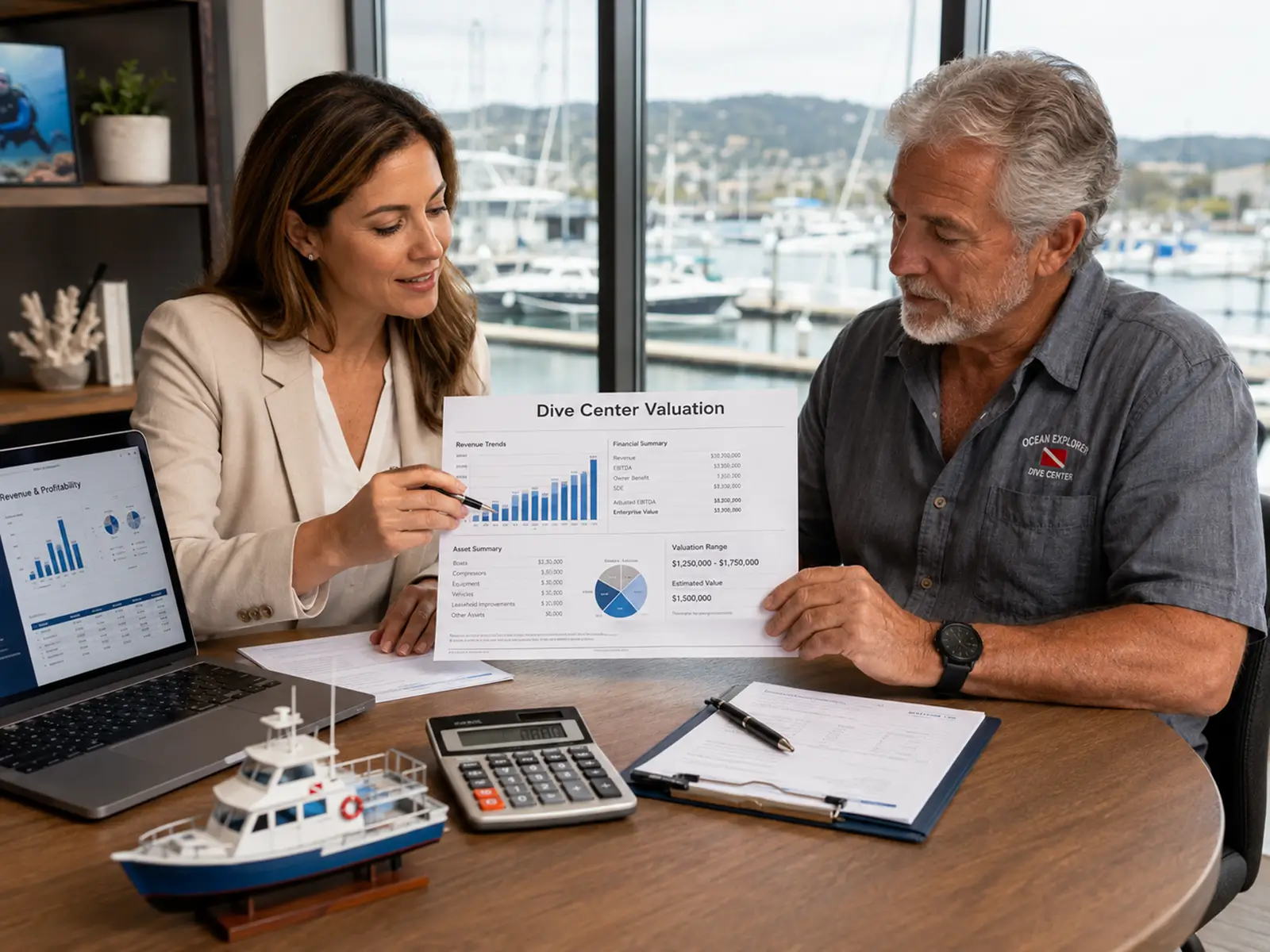
How to Value a Dive Center Before Buying or Selling
Valuing a dive center is one of the hardest parts of buying or selling a scuba business.
A seller may see years of work, reputation, equipment, loyal customers and lifestyle value. A buyer may focus on profit, risk, required investment and how difficult the business will be to take over.
Both sides are looking at the same business, but often from very different perspectives.
On "Dive Listings", sellers can list dive centers, dive shops, dive boats and liveaboards, while buyers can compare opportunities in different destinations. But before a serious deal happens, both sides need to understand one thing clearly:
The asking price is not always the same as the real value.
This guide explains the main factors that affect the value of a dive center or scuba diving business.
1. Start With the Real Profit
Profit is usually one of the most important parts of valuation.
A dive center with strong revenue but weak profit may not be worth as much as it looks from the outside. A smaller business with stable profit, low costs and simple operations may be more attractive than a larger business with high expenses.
When valuing a dive center, look at:
- Annual revenue
- Net profit
- Owner salary
- Staff costs
- Rent
- Boat costs
- Equipment maintenance
- Compressor maintenance
- Marketing costs
- Insurance
- Seasonality
- One-time expenses
- Debt or finance payments
The key question is not only:
How much does the business sell?
The better question is:
How much money does the business realistically produce for the owner after normal operating costs?
This is why revenue alone can be misleading. We will cover this topic more deeply in "revenue vs profit in dive business valuation".
2. Normalize the Numbers
Before valuing a dive center, the financial numbers often need to be adjusted.
Some expenses may be personal. Some costs may be one-time. Some income may not repeat. Some owner work may not be properly counted as a salary.
For example, a seller may show good profit because they work full-time without paying themselves a normal wage. A buyer then has to ask:
If I need to hire someone to replace the owner, what happens to the profit?
Other adjustments may include:
- One-time repairs
- Personal expenses paid by the business
- Owner salary not shown properly
- Unusual high or low season
- Temporary closures
- Non-recurring income
- Family labor not paid at market rate
The goal is to find a realistic ongoing profit level.
A business should not be valued only on its best year or on numbers that cannot be repeated.
3. Look at Asset Value
A dive center often has valuable physical assets.
These may include:
- Rental dive equipment
- Tanks
- Compressor
- Filling system
- Oxygen equipment
- Boats
- Engines
- Vehicles
- Retail stock
- Tools
- Office equipment
- Website and digital assets
But asset value must be realistic.
A regulator bought five years ago is not worth its original purchase price. A boat may look valuable but need engine work. A compressor may be important but expensive to service. Retail stock may be slow-moving or outdated.
When valuing assets, consider:
- Age
- Condition
- Service history
- Replacement cost
- Current resale value
- Safety standards
- Whether the asset is owned, leased or financed
- Whether the buyer actually needs it
A business with strong assets may justify a higher price, especially if those assets reduce the buyer’s startup costs.
We will cover this topic separately in "equipment and asset value".
 |
4. Separate Business Value From Equipment Value
This is important.
A dive center is not only a collection of equipment. It is also a business with customers, reputation, systems, location and earning power.
A business may have modest equipment but strong profit and excellent reviews. Another may have expensive equipment but weak bookings and poor organization.
The buyer should understand both parts:
Asset value — what the equipment, boats, compressor and other items are worth.
Business value — what the operating business is worth because it generates income.
A common mistake is to price a weak business too high because the seller adds up equipment at unrealistic values.
Another mistake is to ignore the value of a strong brand, good location and repeat customer base.
A balanced valuation looks at both.
5. Check the Lease and Location
Location can strongly affect value.
A dive center near hotels, a marina, a beach, a busy tourist street or strong dive sites may be more valuable than a similar business in a weaker location.
But location only creates value if the buyer can keep using it.
Important questions include:
- How long is left on the lease?
- Can the lease transfer to a buyer?
- Is rent reasonable?
- Are there renewal options?
- Is the landlord supportive?
- Does the lease allow dive operations?
- Are storage, signage and compressor use allowed?
- Is access to the sea, beach or marina secure?
A dive center with strong profit but a lease ending soon may be risky.
A slightly smaller business with a secure long-term location may be more valuable because the buyer has more stability.
6. Licenses and Permits Affect Value
A dive business can lose value quickly if licenses or permits are unclear.
Depending on the country and business type, value may depend on:
- Business registration
- Tourism license
- Dive operation permit
- Boat permissions
- Marina or harbor rights
- Environmental permissions
- Compressor inspection documents
- Insurance
- Staff qualification requirements
The key question is not only whether the current owner can operate.
The buyer needs to know whether the business can continue operating after the sale.
If licenses are transferable, current and properly documented, this can support value. If they are missing, expired or personal to the seller, the risk increases and the value may be lower.
This is especially important when "buying a dive business abroad".
7. Online Reputation Has Real Value
A modern dive center’s reputation can be one of its strongest assets.
Strong online reputation may include:
- Google reviews
- TripAdvisor reviews
- Facebook reviews
- Social media following
- Website traffic
- Online booking history
- Repeat customers
- Customer photos and testimonials
- Good local search visibility
A dive center with strong reviews and steady online inquiries may be easier for a buyer to continue.
But reputation value depends on transferability.
If reviews are connected to the business name, location and Google profile, they may support the sale. If the reputation depends mostly on the current owner personally, the buyer may not receive the same value.
A strong brand is valuable when it can continue working under new ownership.
 |
8. Owner Dependence Can Lower Value
Many dive centers depend heavily on the owner. That is normal, especially in small businesses.
But high owner dependence can reduce value.
A buyer will look at questions like:
- Does the owner teach most courses?
- Does the owner manage all bookings?
- Does the owner drive the boat?
- Does the owner repair equipment?
- Does the owner hold key licenses?
- Does the owner have all hotel relationships?
- Does the business rely on the owner’s personality?
If the business cannot run without the current owner, the buyer takes more risk.
A dive center with systems, staff, clear procedures and transferable relationships is usually easier to value positively.
A business where everything is inside the owner’s head may still be sellable, but the price should reflect the takeover risk.
9. Seasonality Changes the Valuation
Seasonality is very important in dive business valuation.
Two dive centers may show the same annual profit, but one may be stable year-round while the other makes most of its money in three months.
The seasonal business may still be valuable, but it requires more careful cash planning.
Buyers will want to know:
- Best months
- Weakest months
- Low-season costs
- Staff needs by season
- Weather-related closures
- Tourism patterns
- Local events or holiday periods
- Cash needed to survive quiet months
A stable year-round business may deserve a stronger valuation than a similar business with high seasonal risk.
But a seasonal business can still be attractive if costs are controlled and the price reflects the pattern.
10. Growth Potential Should Be Realistic
Growth potential can support value, but it should not replace proven performance.
Many sellers say the business has huge potential. Buyers hear this often.
A stronger valuation case shows practical growth opportunities, such as:
- Better website and SEO
- Online booking improvements
- Hotel partnerships
- New course packages
- Private charters
- Snorkeling or freediving programs
- Retail expansion
- Multilingual marketing
- Better social media advertising
- Low-season packages
The buyer will ask:
If this growth is so clear, why has it not already happened?
There may be a good answer. The owner may be retiring, tired, under-marketing the business or lacking digital skills.
But growth potential should be realistic, not just optimistic.
11. Risk Reduces Value
Valuation is not only about what the business earns. It is also about how risky those earnings are.
Value may be reduced by:
- Short lease
- Missing licenses
- Old equipment
- Weak financial records
- High owner dependence
- Heavy seasonality
- One major customer source
- Poor reviews
- Staff instability
- Strong local competition
- Expensive boat repairs
- Unclear digital asset ownership
- Unpaid debts or disputes
A buyer may still buy a business with these risks, but they will usually expect a lower price or better deal terms.
A cleaner, more stable business usually supports a stronger asking price.
We will cover this in more detail in "what increases or lowers the value of a dive business".
 |
12. Compare Similar Opportunities
Market comparison can help, but it must be used carefully.
A seller may compare their dive center with another business listed at a high asking price. But listing price does not always mean selling price.
When comparing opportunities, look at:
- Location
- Revenue
- Profit
- Assets included
- Lease security
- Equipment condition
- Boat ownership
- Staff structure
- Reviews
- Seasonality
- Licenses
- Growth potential
A dive center in a year-round destination with strong reviews and secure lease may not be comparable to a seasonal center with old equipment and unclear financials.
Use similar listings as a guide, not as proof.
13. Asking Price Should Match the Story
A good asking price should be easy to explain.
For example:
- The business has stable profit.
- The assets are in good condition.
- The lease is secure.
- The brand has strong reviews.
- The equipment is included.
- The handover is clear.
- Growth opportunities are realistic.
If the asking price is high but the explanation is weak, buyers may lose confidence.
If the asking price is realistic and supported by clear information, buyers are more likely to take the opportunity seriously.
For sellers, this means preparation matters. For buyers, it means asking why the price is what it is.

14. Valuation Is a Range, Not One Perfect Number
A dive center does not usually have one exact value.
It often has a value range.
The final price may depend on:
- Buyer motivation
- Seller motivation
- Financing
- Payment terms
- Included assets
- Handover support
- Timing
- Competition from other listings
- Risk level
- Local market demand
A buyer may pay more for a business that fits their lifestyle, skills and location goals.
A seller may accept less for a clean, fast and confidential sale.
Valuation helps both sides understand a realistic range, but negotiation still matters.
Final Thoughts
Valuing a dive center requires more than looking at the asking price.
A realistic valuation should consider profit, assets, lease security, licenses, equipment condition, online reputation, staff structure, owner dependence, seasonality, risk and growth potential.
For sellers, a clear valuation helps set a more credible asking price.
For buyers, it helps avoid overpaying for a business that looks attractive but carries hidden risk.
The best dive business value is not always found in the cheapest listing or the highest-revenue operation. It is found where the numbers, assets, location, systems and risk all make sense together.
A good valuation does not need to be complicated, but it must be honest.
Next Steps for Buyers and Sellers
If you are buying, start with our guide on "how to buy a dive center" before comparing prices.
If you are selling, read "how to sell a dive center" before setting your asking price.
To understand the numbers more clearly, read "revenue vs profit in dive business valuation".
To value physical assets properly, review "equipment and asset value".
You can also explore more guides in our "Dive Business Valuation" section on "Dive Listings".
 |